
Responsible Gambling: A Practical Guide for New Zealand Players
Responsible gambling starts with treating casino play as entertainment rather than a way to make money. At Rizk Casino, our role is to provide independent gambling information, reviews and educational content that helps New Zealand readers make informed decisions. Gambling always involves financial risk, and no strategy, bonus or game can remove the possibility of losing money.
This page explains practical ways to keep gambling within sensible boundaries, recognise when recreational play may be becoming harmful, and find appropriate support when gambling begins affecting finances, relationships or emotional wellbeing. Our website is an independent iGaming and affiliate information platform, not a casino operator, and the information here should not be treated as personal financial, legal or medical advice.
Keeping Gambling in Its Proper Place
A useful approach to responsible gaming is to decide in advance what role gambling has in your life. Casino games should sit alongside other forms of recreation, not replace ordinary social activities, work, study or financial priorities. Before playing, consider whether you can comfortably afford the amount you intend to spend without using money needed for rent, food, bills, debt repayments or other essential commitments.
Healthy gambling also means accepting the outcome of every wager. Wins are not guaranteed, losses cannot reliably be recovered by placing another bet, and a game does not become more likely to pay simply because it has recently produced several losing results. Keeping these principles in mind can reduce impulsive decisions and make it easier to walk away when your planned gambling session or budget has ended.
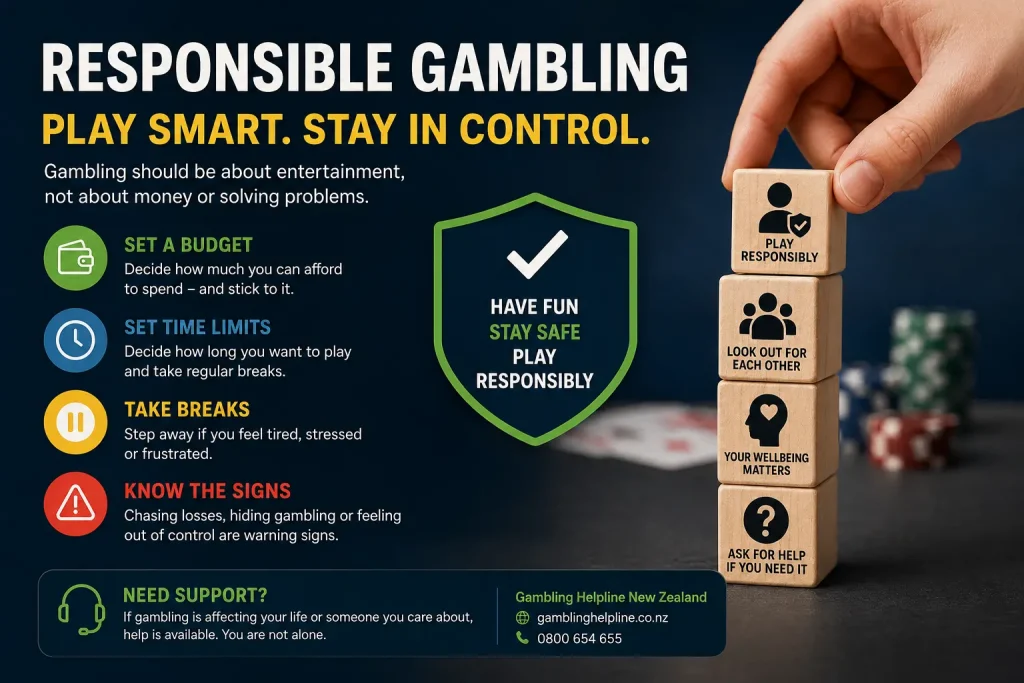
- Set a gambling budget before you start.
- Decide how long you intend to play and take regular breaks.
- Never gamble with money required for essential expenses.
- Do not increase stakes simply because you have lost.
- Avoid gambling when you are distressed, angry, exhausted or under the influence of alcohol or drugs.
- Keep gambling separate from borrowing and credit intended for everyday expenses.
It can also help to keep a simple record of deposits, withdrawals and playing time. Looking at actual spending rather than relying on memory gives you a clearer picture of your gambling habits. If the numbers are becoming uncomfortable or you find yourself regularly exceeding the limits you originally chose, that is a reason to pause and reassess rather than increase your budget.
When Casual Play Starts Feeling Different
Problem gambling does not always develop suddenly. Changes can be gradual and may initially appear harmless, particularly when gambling is being used to escape boredom, loneliness, stress or disappointment. A warning sign can be a growing need to gamble for longer or with larger amounts to achieve the same excitement, especially when previous limits no longer feel realistic.
Other concerns include repeatedly thinking about gambling when you are not playing, hiding deposits or losses from people close to you, becoming irritable when unable to gamble, cancelling plans to continue a session, or returning to gambling primarily because you want to recover previous losses. These behaviours do not automatically mean someone has a gambling disorder, but they are useful reasons to stop and consider whether additional support would be helpful.
Questions worth asking yourself
- Have I recently spent more than I originally intended?
- Do I gamble to change how I feel rather than simply for entertainment?
- Have I tried to cut back but found it difficult to follow through?
- Have gambling losses affected bills, savings or other financial commitments?
- Am I keeping my gambling activity secret from someone I trust?
- Would I feel uncomfortable if someone close to me saw my recent gambling history?
If several answers concern you, taking a break is a sensible first step. You do not need to wait until gambling has caused serious financial or personal damage before asking for help. Early support can provide practical strategies for changing behaviour and can also help family members understand what they can do without taking responsibility for another person’s gambling.
Gambling harm can affect much more than a bank balance. Persistent gambling may contribute to debt, conflict, anxiety, reduced concentration, disrupted sleep and withdrawal from friends or whānau. Conversely, financial pressure can intensify emotional distress and make gambling feel like an attempted solution. Breaking that cycle often requires addressing both the gambling behaviour and the underlying pressures surrounding it.
Build a Gambling Budget Before You Deposit
A gambling budget works best when it is treated as entertainment spending rather than money that is expected to come back. Start by identifying the income available after essential household costs, debt commitments and savings. Only an amount that you could genuinely afford to lose should be considered for gambling. If losing that amount would create stress or interfere with another financial obligation, the appropriate gambling budget is zero.
Consider using separate spending controls wherever they are available. Deposit limits, wagering limits, session reminders, cooling-off periods and temporary account restrictions can create useful distance between an impulse and a financial transaction. Current New Zealand online casino regulation is being introduced in stages, with the new framework placing greater emphasis on harm prevention, consumer protection and controls such as time, deposit and spend limits.
| Control | How it can help |
|---|---|
| Pre-set gambling budget | Defines the maximum amount you are prepared to lose. |
| Deposit limit | Restricts how much money can be added during a chosen period. |
| Time reminder | Helps you notice how long a gambling session has lasted. |
| Banking controls | Can add another barrier between an impulse and a gambling payment. |
| Temporary break | Creates space to reassess gambling without making permanent decisions immediately. |
Banking safeguards may include transaction notifications, spending alerts, reduced payment limits or asking your bank what gambling-related controls it can provide. These measures are most useful when combined with a clear personal budget. No banking feature should be viewed as a substitute for addressing harmful gambling behaviour or seeking professional assistance when control has already become difficult.
Taking a Deliberate Break or Stepping Away
Sometimes the most effective responsible gambling decision is to stop completely for a period of time. Depending on the platform, players may be able to use a temporary timeout, account closure or voluntary self-exclusion arrangement. Self-exclusion is designed to create a stronger barrier to gambling and can be particularly useful when ordinary spending limits have repeatedly been ignored.
Because self-exclusion arrangements can differ between gambling providers and venues, players should check the exact conditions before activating one. A person who decides to stop gambling should also consider removing saved payment details, deleting gambling applications, unsubscribing from promotional messages and reducing access to gambling websites. These practical steps can make a decision to take a break easier to maintain.
Digital barriers can add another layer
Website and device blocking software may help prevent access to gambling services during a period away from gambling. One example is Gamban, which provides gambling-blocking software designed to restrict access across supported devices. Blocking software is a practical tool, but it should be considered part of a broader plan rather than a complete treatment for gambling harm.
For venue-based gambling, New Zealand also has statutory exclusion mechanisms under the gambling framework. Online arrangements are developing alongside the country’s new online casino regulatory system, so consumers should check the current rules and the individual operator’s procedures rather than assuming that one exclusion automatically applies everywhere.
Protecting People Who May Be More Vulnerable
Responsible gambling also involves protecting people who may be particularly vulnerable to gambling-related harm. This includes minors, people experiencing financial hardship, individuals dealing with significant emotional stress and anyone whose gambling behaviour has previously caused problems. Gambling content should never be presented to children as entertainment that is suitable for them, and adults should take reasonable steps to prevent minors from accessing gambling accounts or payment methods.
Households can reduce accidental access by using strong passwords, keeping payment credentials private, enabling device security and avoiding leaving gambling accounts logged in on shared devices. Parents and caregivers may also want to use age-appropriate parental controls where available. These measures are especially important when children or young people have access to phones, tablets or computers used by adults in the household.
Friends and whānau can sometimes notice changes before the person gambling does. A useful conversation should focus on specific observations rather than blame. Explain what you have noticed, ask how the person is coping, listen without immediately judging and encourage them to consider professional support. Avoid paying gambling debts, providing money for continued gambling or taking over financial responsibilities in a way that unintentionally allows harmful behaviour to continue.
If gambling is creating serious pressure within a household, support can be useful for family members as well as the person gambling. Gambling harm can affect trust, communication, household finances and emotional wellbeing, so relatives do not have to manage the situation alone.
Facts That Make Gambling Easier to Understand
Gambling myths can encourage risky decisions. A common misconception is that a losing streak means a win must be coming soon. Random games do not owe a player a particular result because previous outcomes were unsuccessful. Another misconception is that skill, a special betting pattern or a particular time of day can guarantee a casino win. In games based substantially on chance, there is no reliable system that removes the underlying risk.
Bonuses also deserve careful attention. A promotional offer is not free cash in the ordinary sense if it comes with wagering requirements, expiry periods, game restrictions or withdrawal conditions. Reading the full terms before accepting an offer is part of responsible gambling. Our FAQ and Terms & Conditions provide additional information about how our website presents gambling-related content.
- A previous loss does not make the next spin or wager more likely to win.
- A winning session does not establish a reliable prediction method.
- Past results generally cannot be used to guarantee future random outcomes.
- A bonus can have conditions that materially affect its value.
- There is no responsible gambling strategy that can guarantee profit.
Understanding these points can make it easier to separate entertainment from expectations of income. If you notice yourself trying to predict outcomes, chase losses or treat gambling as a solution to financial problems, stepping away is usually more useful than searching for a better betting system.
Where New Zealanders Can Turn for Real Support
Professional assistance is appropriate whenever gambling begins to feel difficult to control, regardless of how large the financial losses may be. New Zealand has specialist services that can help people understand gambling harm, develop practical strategies and work through related financial or emotional difficulties. Seeking help is not an admission of failure; it is a constructive way to regain control.
The Gambling Helpline New Zealand provides free support for people affected by gambling, including people concerned about someone else’s gambling. The service offers confidential assistance, referrals and practical guidance, with specialist options available for different communities and circumstances. It can be a useful first point of contact when you are unsure what kind of help you need.
Support can also involve a GP, counsellor, financial mentor or another qualified professional. Financial difficulties should be addressed separately from the urge to recover gambling losses. Creating a realistic repayment plan and obtaining independent financial guidance can be more effective than attempting to win back money through further gambling.
If gambling has contributed to severe emotional distress or you feel unable to keep yourself safe, seek urgent assistance through appropriate emergency or health services in New Zealand. Do not rely on gambling to change your circumstances in a crisis. Immediate personal safety takes priority over debts, losses, account balances or any other gambling concern.
New Zealand Rules and the Role of This Website
New Zealand’s online gambling environment is undergoing a significant regulatory transition in 2026. The Online Casino Gambling Act 2026 has established a new framework for licensing online casino operators, with implementation being phased in. The Department of Internal Affairs is responsible for administering the developing regulatory system, including requirements concerning consumer protection and gambling harm.
The position for online casino customers is therefore not static. Readers should check current official information before relying on an assumption about whether a particular operator can lawfully provide services to people in New Zealand. The Department of Internal Affairs online casino guidance provides current information about the regulatory transition, licensing process and consumer protections.
Our website is an independent gambling information and affiliate platform. We publish educational guides, casino reviews, bonus information, game content and payment-method material for informational purposes. We are not a casino operator, do not hold customer gambling accounts and do not process deposits or withdrawals. Readers should independently verify the current legal and regulatory position before choosing whether to use any gambling service.
Some pages on our website may contain affiliate links. If a reader follows an affiliate link and subsequently takes an action with a third-party service, we may receive compensation. Affiliate relationships do not remove the need for responsible gambling, and commercial relationships should never be interpreted as a guarantee that a gambling service is suitable for an individual player.
Our editorial approach is intended to give readers useful information while acknowledging the risks associated with gambling. You can learn more about who we are through our About page and review our Privacy Policy to understand how information relating to visitors is handled.
Questions New Zealand Players Often Ask
What does responsible gambling actually mean?
Responsible gambling means keeping gambling within boundaries that protect your money, time and wellbeing. It includes setting realistic limits, accepting losses, avoiding chasing behaviour and taking breaks when gambling stops feeling recreational. It also means recognising when additional support may be appropriate rather than waiting for serious harm to occur.
Should I gamble if I need the money to cover expenses?
No. Gambling should not be funded with money required for rent, food, utilities, debt repayments or other essential commitments. Trying to turn gambling into a method of paying bills can increase pressure and encourage chasing losses. If finances are already difficult, independent financial support is generally a more appropriate route than further gambling.
Can self-exclusion help if I keep exceeding my limits?
It can. A voluntary self-exclusion arrangement creates a stronger barrier than an ordinary spending limit and may be useful when attempts to control gambling independently have not worked. You should check the specific self-exclusion rules offered by the relevant provider and consider additional measures such as payment controls and gambling-blocking software.
What should I do if I am worried about someone else’s gambling?
Start with a calm conversation based on specific behaviour you have observed. Avoid shaming or threatening the person, and encourage them to speak with a specialist support service. Protecting your own finances is also important, so avoid giving money specifically to fund gambling or taking on gambling-related debts without independent advice.
Is there a system that can guarantee a casino profit?
No. There is no betting pattern, staking method, lucky sequence or gambling strategy that can guarantee a profit from games involving chance. Previous results do not create an obligation for a future win. A responsible approach is to regard any amount spent as money that could be lost in full.
Where can I start if gambling is becoming difficult to control?
Begin by stopping or reducing gambling, securing access to your money, removing easy access to gambling platforms and speaking with a qualified support service. In New Zealand, the Gambling Helpline can provide confidential guidance and help identify appropriate next steps for you or someone affected by gambling harm.
A Responsible Gambling Approach for Every Visit
Responsible gambling is ultimately about maintaining choice. If you can decide when to play, how much to spend and when to stop without significant pressure to continue, you are in a stronger position to keep gambling within its intended entertainment role. If those decisions are becoming difficult, changing course early is more important than finding a way to continue playing.
Before using gambling information or following any offer discussed on our website, take a moment to consider your own circumstances, financial position and wellbeing. Gambling should never come before essential expenses, relationships, health or personal safety. No review, bonus, game guide or affiliate recommendation can change the fundamental fact that gambling carries a risk of financial loss.
If you have a question about the responsible gambling content published on our platform, an editorial concern or a request relating to this page, you can contact our team at [email protected] or use our Contact page. We welcome responsible gambling enquiries and feedback that can help us keep our New Zealand-focused information clear, accurate and useful.
For the latest legal information, readers should rely on official New Zealand government sources and the applicable legislation rather than treating an affiliate website as a substitute for legal advice. Our responsible gambling information is educational in nature and is intended to encourage informed decisions, early recognition of gambling harm and appropriate use of professional support.